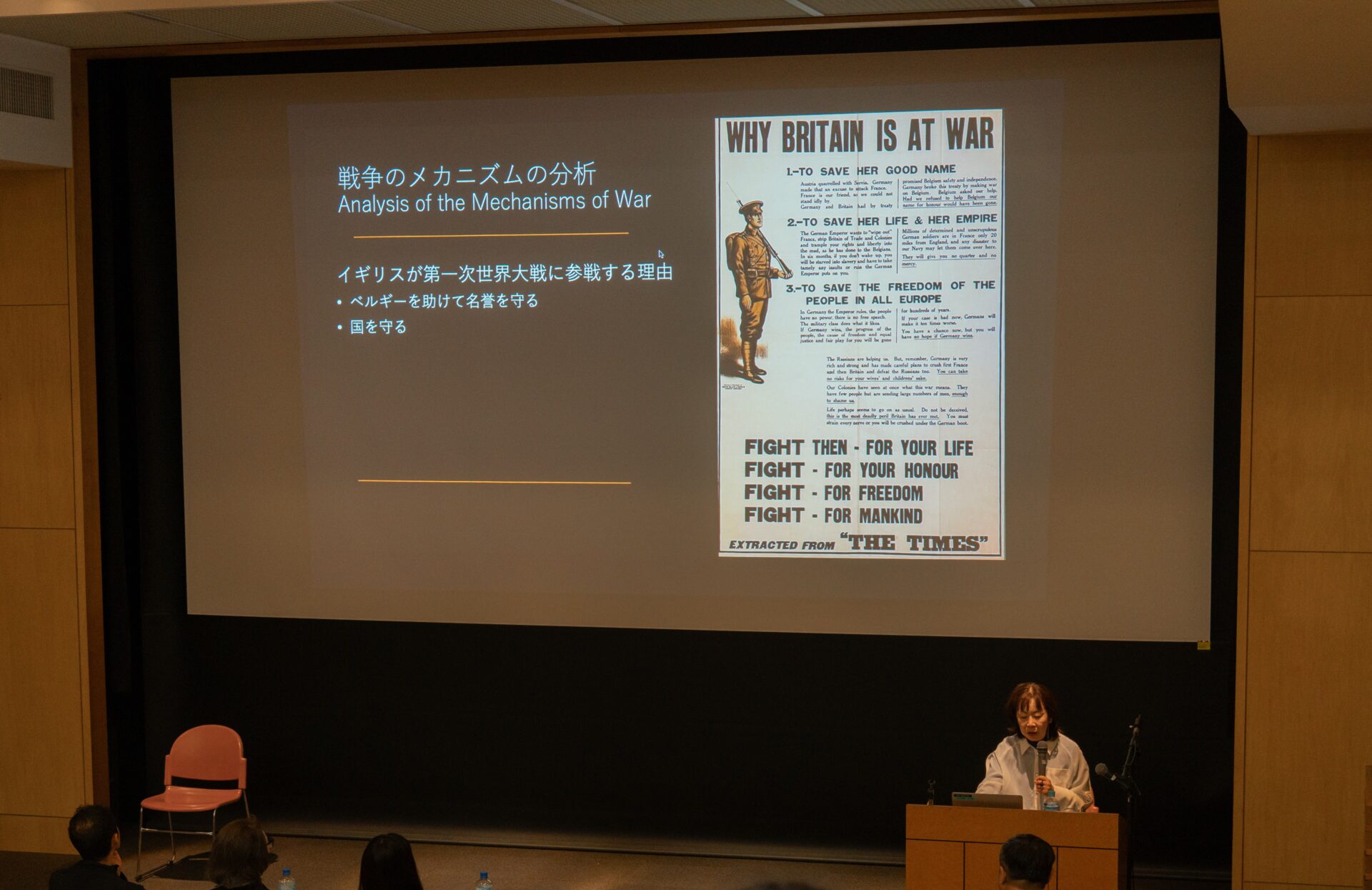
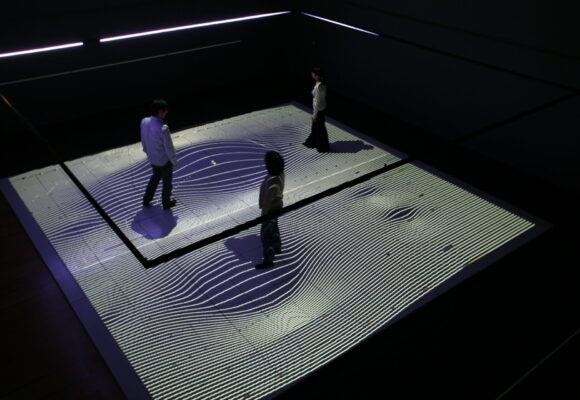
Photo: Kota Shiga
From Digitization to the Preservation of Memory: Exploring the Potential of Art Through the Symposium How Does Art Engage with History?
In recent years, numerous exhibitions that take a critical view of past imperialism and traditional art history have been held at museums and art festivals around the world. There is a growing global movement to shine a light on artists who trace their roots to former colonies, call attention to previously underrepresented female artists, and to give voice to those who have been silenced.
In Japan, in contrast, the 2019 Aichi Triennale saw the government join forces with right-wing groups and members of the public in criticizing works such as the “Statue of Peace,” which evokes memories of wartime “comfort women.” This illustrates a situation where even the mere mention of history can spark controversy.(1)
Can we confront the past and discuss history within the context of art without resorting to emotional arguments? In an attempt to do just that, I organized the symposium How Does Art Engage with History? and invited five presenters.(2) Among them were Jananne Al-Ani, an Iraqi-born British artist with whom I have maintained a working relationship since her participation in the exhibition The World is a Stage: Stories Behind Pictures (2005) (3), which I curated at the Mori Art Museum; Aomi Okabe, a curator and critic who has observed global art trends; Chien-Hung Huang, a professor at Taipei National University of the Arts and a curator who has organized international exhibitions as director of the Kuandu Museum of Fine Arts; Erika Kobayashi, who explores the history of radiation and the stories of the women involved; and Hikaru Fujii, who addresses historical and political issues through the medium of video. I also took the stage myself alongside these participants.
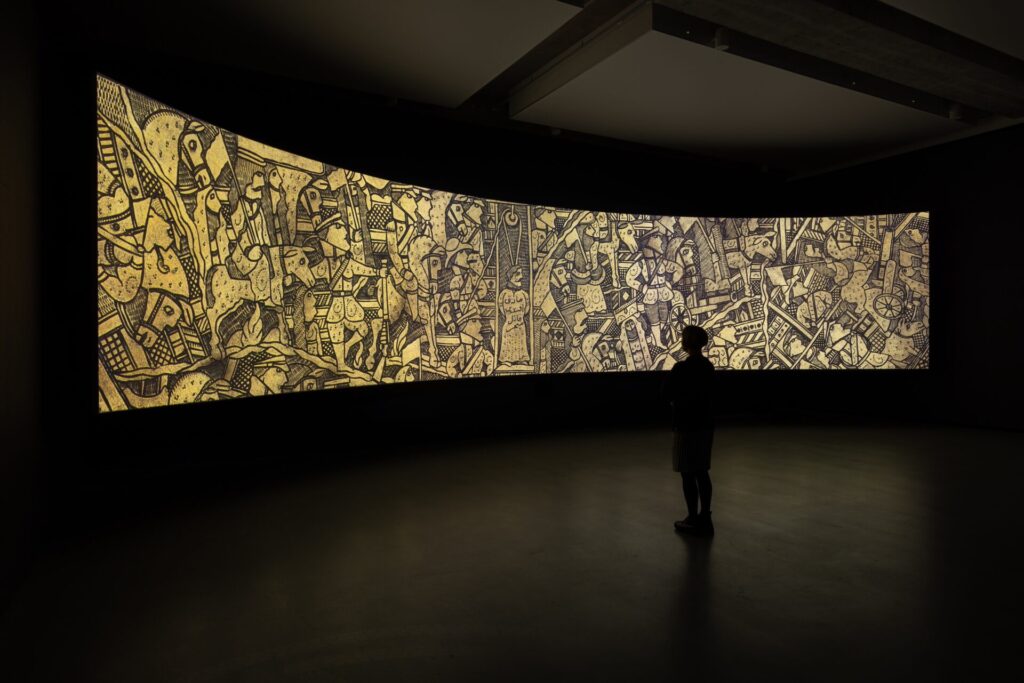
Jananne Al-Ani, Timelines, 2022, Panoramic Video Installation © Jananne Al-Ani. Installation view, Towner Eastbourne. Photo by Rob Harris
Jananne Al-Ani, participating online from London, presented a screening of her video work Timelines (2022) (4)followed by a talk. The impetus for this work was a brass tray(5), shown to her by a curator at the Victoria and Albert Museum (V&A), which was believed to commemorate Armistice Day in 1918 when the Allied powers, led by Britain, defeated the Ottoman Empire toward the end of World War I. Al-Ani composed her narrative by pairing her mother’s voice with close-up footage of the crowd scenes engraved on the tray.
Al-Ani noted that the illustration on the tray depicts a man being hanged for the murder of a British major. She speculated that this scene might reflect the Iraqi uprising against the British army. Britain had reneged on its promise to grant Iraq independence following the fall of the Ottoman Empire and was administering postwar Iraq under a mandate based on the Sykes-Picot Agreement, which it had secretly concluded with France.
Following the exhibition of Timelines, new testimonies relating to events depicted on the tray emerged, and the V&A subsequently added a new interpretation to the tray’s description, stating that it may depict a “revolt against the British in Iraq in 1920, aimed at gaining independence.” (5)
This approach to research, which could be described as collaboration between the artist and the museum, is highly significant. Al-Ani once told me a fascinating story about her relationship with the Imperial War Museum (IWM). The IWM commissioned her video work A Loving Man (1996–1999) and has since added it to its collection. The “man” spoken of in this work—which was also featured in the aforementioned exhibition The World is a Stage: Stories Behind Pictures—is Al-Ani’s Iraqi father. The work is rooted in the history of her family: Al-Ani herself moved from Iraq to the UK with her Irish mother, leaving her father behind. We catch a glimpse of the complex reality faced by this family caught up between political dividing lines.
Amid ongoing tensions between the UK and Iraq, which have persisted since the Gulf War (1990–91) and the Iraq War (2003–2011), it is noteworthy that the IWM commissioned Al-Ani, who has Iraqi roots, to create this work. Furthermore, I highlighted that in recent years, the IWM has curated exhibitions that address issues inherently tied to war—including soldiers’ PTSD (6) and the link between war and sexual violence(7)—as well as the wars waged by Britain after World War II to obstruct the independence of its former colonies(8), continuing a critical examination of the nation’s history. Such initiatives would be unimaginable for Japanese museums.
Aomi Okabe introduced the exhibition The Bührle Collection: A future for the past. Art, context, war and conflict (9), held at the Kunsthaus Zürich. The exhibition exposed Nazi-looted artworks within the collection of Emil Georg Bührle, a major benefactor of the museum, and questioned Bührle’s ethics as an arms dealer. During the exhibition, investigations by city and state authorities revealed that more than half of the works on long-term loan from the Bührle Foundation to the museum had previously belonged to Jewish owners. Problematic works were marked with blue captions, and detailed provenance information was provided via QR codes. Raising such issues without shying away from self-criticism could serve as an opportunity for the museum to transcend its role as a “temple of beauty” and become a social entity.
Okabe also pointed out that there are gaps in Japan’s colonial history and that the country’s handling of artworks that should be returned has been inadequate.
Chien-Hung Huang argued that although Taiwan does not possess the right to wage war as a nation-state, external powers continue to clash at the societal level, resulting in a constant conflict over rights. Given Taiwan’s complex history of rule by the Netherlands, Spain, the Qing Dynasty, Japan, and the Kuomintang, he contends that the island remains in a state of “unrestricted warfare.”
Given this context, it is perhaps inevitable that many Taiwanese artists would address historical issues. Chen Chieh-Jen highlights historical trauma and the plight of exploited workers(10), while Kao Jun-Honn investigates the violent suppression of Taiwan’s indigenous peoples during the Japanese colonial era.(11) Tsai Pou-Ching reinterprets the history of the same era using a unique approach that incorporates perspectives from both the animal and scientific worlds.(12)
Huang asserted that Taiwanese artists will continue to question, without fear, the never-ending divisions and wars afflicting the island.
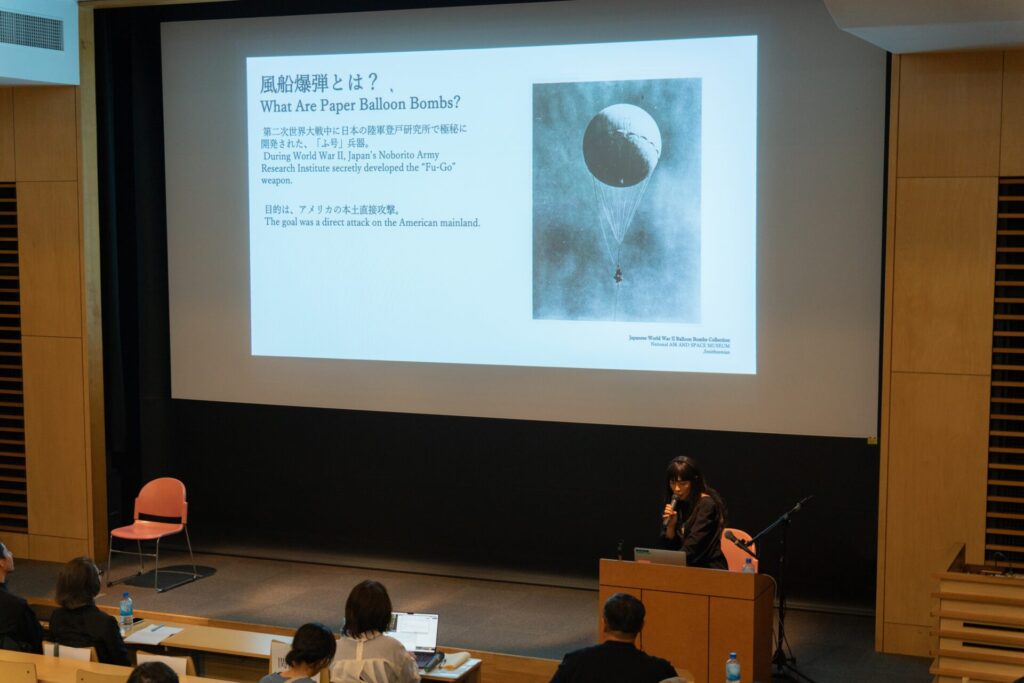
Photo: Kota Shiga
Erika Kobayashi, author of Girls, Making Paper Balloon Bombs (13), spoke about the young girls in wartime Japan who were conscripted as student laborers to make balloon bombs. Late in the Pacific War, the Japanese military secretly manufactured balloon bombs with a diameter of about 10 meters using washi paper and konjac starch paste. Of the approximately 9,300 bombs launched, about 1,000 reached the United States, and it is reported that six civilians in the state of Oregon were killed by these weapons.
Schoolgirls from across the country were conscripted to make the bombs, a task deemed suitable for “young female students with nimble fingers.” Kobayashi has been researching the students from Futaba, Atomi, and Kojimachi Girls’ High Schools who labored at the Tokyo Takarazuka Theater in Yurakucho without being told the purpose of their work. She noted that some of those involved were later shocked to learn the truth, which was concealed until long after the war.
Kobayashi analyzes the culpability and agency of young girls, who are typically portrayed as victims or the vulnerable. She imagines herself in the shoes of those girls from the past, who eagerly made care packages for soldiers and devoted themselves to mobilization efforts. How would we act if we were in their position? That is a question without a clear answer.
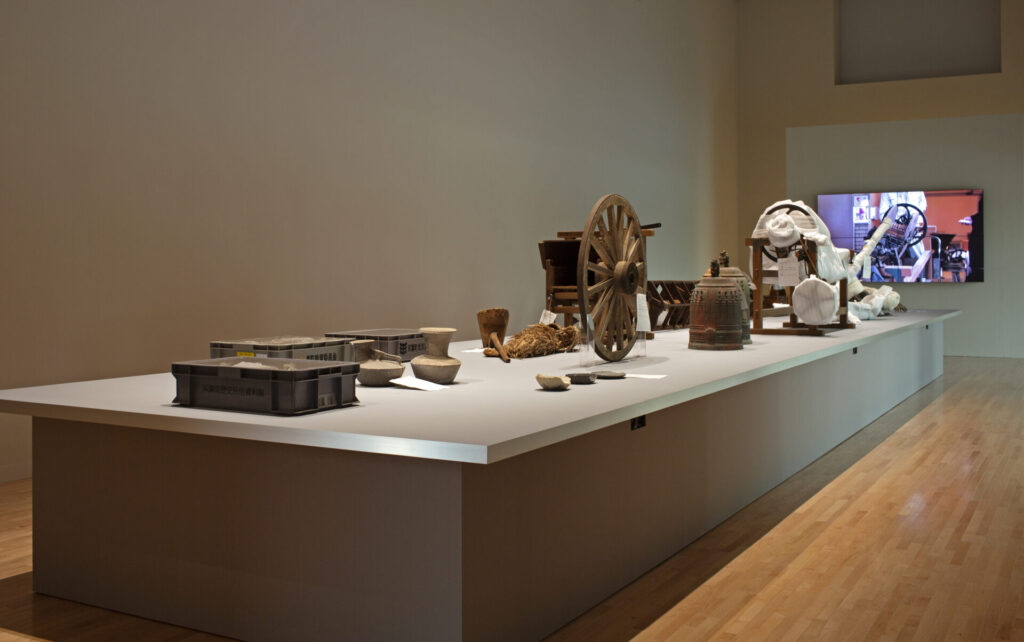
Hikaru Fujii, The Anatomy Class, 2020, Film Installation Photo by Hikaru Fujii
Hikaru Fujii said that the Fukushima Daiichi nuclear disaster of 2011 was what sparked his keen awareness of history. In his video installation The Anatomy Classroom (2020), he spotlights the removal of from a museum located within the “restricted zone.” At the time, the museum’s curator created guidelines for the relocation of these items by drawing on the experience of the Chernobyl nuclear disaster. The history of the region spanning thousands of years, as revealed by the cultural properties, overlaps with the history of the most severe nuclear accident of the twentieth century, all while a new emergency unfolds before our eyes.(14) In The Classroom Divided by a Red Line (2021), Fujii addresses the trauma and structures of discrimination experienced by children from Fukushima who evacuated to other regions.(15)He shows how the discrimination once faced by atomic bomb survivors resurfaces in the twenty-first century, and how the narrative of “reconstruction” is manufactured in the run-up to the Tokyo Olympics, under the then-prime minister’s directive that “the situation is under control.”
Fujii also argued that the U.S. military’s confiscation of Japanese war paintings how Japan’s collective memory of the war in Asia was placed under the control of an occupying force.(16) With the onset of the Cold War, Japan’s war responsibility was obscured, and history was rewritten by the new powers that be.
This symposium was significant in the sense that it reaffirmed the importance of reflecting on and examining past imperialism and wars from diverse standpoints and perspectives. As Fujii stated, “If we merely absorb history as knowledge, we will be buried in a vast sea of information and eventually forget. What is needed is not the digitization of information for the sake of knowing, but the preservation of memory to ensure we do not forget.” It is precisely in this “preservation of memory” that art can play a powerful role. I believe it is the responsibility of those of us living here and now to listen to the voices hidden behind the historical narratives dictated by victors, and to bring forgotten issues to the public’s attention.
References
1. Natsumi Araki, “Aichi Triennale 2019 wo ima koso miru. ‘Maboroshi no sakuhin’ kara kangaeru” (“Seeing the Aichi Triennale 2019 Now. Reflections on the ‘Phantom Works’”). Asahi Shimbun Globe+, September 21, 2019.
2. Symposium: How Does Art Engage with History? Tokyo University of the Arts, December 20, 2025.
3. “The World is a Stage: Stories Behind Pictures,” Mori Art Museum, 2005.
4. The work was first screened at the Towner Eastbourne museum. “Jananne Al-Ani Timelines,” Towner Eastbourne, 2022
5. “Tray,” 1918, Collection of Victoria & Albert Museum
6. “War and the Mind,” Imperial War Museum London, 2024-2025
7. “Unsilenced: Sexual Violence in Conflict,” Imperial War Museum London, 2025
8. “Emergency Exits: The Fight for Independence in Malaya, Kenya and Cyprus,” Imperial War Museum London, 2025-2026
9. “The Bührle Collection: A future for the past. Art, context, war and conflict.,” Kunsthaus Zürich, 2023-2025
10. Chen Chieh-jen, “About Artist”
11. Kao Jun-Honn “Llyong Topa,” 2020
12. “Specimen of Empire—Tsai Pou-ching Solo Exhibition,” Taipei Fine Arts Museum, 2024
13. Erika Kobayashi, Reading drama “Onnanoko tachi fuusen bakudan wo tsukuru” (“Girls, Making Paper Balloon Bombs”), Oji Hall, June 19, 2023 | Erika Kobayashi, “Onnanoko tachi fuusen bakudan wo tsukuru” (“The Girls are Making Balloon Bombs”), Bungeishunju, 2024
14. Hikaru Fujii, “The Anatomy Classroom,” 2020
15. Hikaru Fujii, “The Classroom Divided by a Red Line,” 2021
16. Hikaru Fujii, “The Japanese War Art 1946,” 2022
Translated by Ilmari Saarinen