Photo: Fumiaki Fujimoto
Boys go through what’s called “voice change”—a dramatic transformation of the voice. Society has come to recognize menstruation and the many other dramatic changes a girl’s body undergoes as something to be taken seriously. But if you think about it, it’s really boys, whose voices change in a way obvious to themselves and everyone else, who face the graver situation. After all, the voice is the single greatest tool humans have for communication.
If the boy in question belongs to a soccer or baseball club, that’s one thing, but if he’s a member of a choir, singing with the beautiful pre-change voice, the shock is immeasurable. It is, quite literally, permanent expulsion from the paradise of a beautiful voice. Short of castration, as with the castrati who thrived in church music and opera from the sixteenth to eighteenth centuries, there is no way to remain on the singing stage.
Yuri Umemoto grew up singing hymns in church, and his beautiful voice was a point of pride both to himself and others in a children’s choir. He has related how he felt intense revulsion as his voice change brought changes to his body and facial bones. His new work, which takes choral music—his own musical roots—as its theme, is titled “I forgot the song and cried,” a title that captures exactly that feeling.
You can no longer sing in your old voice. A song you stop singing gets forgotten, and it’s fine if it is. But that is a sad thing…
The piece sharing the album’s title, “dumb trick #7,” has its refrain sung by a children’s choir that Umemoto himself can never again take part in. That is a sorrowful thing, and it conveys, quietly and deeply, that a human being is a creature destined to be cast out of every state of happiness in life and driven, inevitably, toward death.
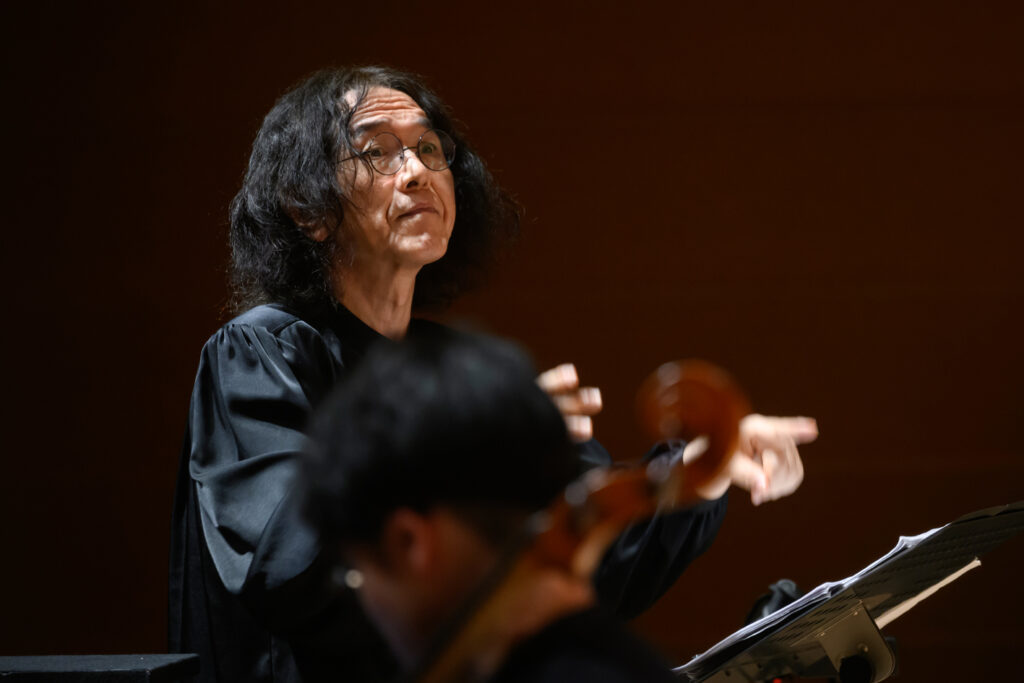
Photo: Fumiaki Fujimoto
Now, the standard practice for a concert unveiling new work is to perform only the composer’s own pieces, but Umemoto inserted works by other composers into his new suite. The three pieces chosen are all masterworks, which risked breaking the flow of his own suite. But contemporary music is part of conceptual art: one’s own work belongs to oneself, and one bears the profit and the credit that flow from it. Seen that way, this became a provocative, anti-marketing act of curation—one that says, “copyright itself is grounded in ego and desire, and here I deliberately cut that thread.”
Incidentally, Umemoto has served as composer-in-residence at Yokohama Minato Mirai Hall since 2025. The subtitle of a concert he held there in the same year was “Digital Maximalism and Music,” and it featured music by Ben Nobuto, whose work also appears in this concert.
“Digital maximalism” was originally a term used critically to describe a way of life built around maximizing connectivity; always-on and proud of it. Music critic Simon Reynolds applied it to electronic music, drawing out characteristics that stand in direct opposition to the minimal techno of the 1990s: an abundance of source material as input, density and scale, complexity and abundance of output, along with brightness, abrupt shifts, exaggerated exhilaration, and the collision of disparate genres.
Ben Nobuto, also featured in this concert, has said that the internet’s sense of “infinite material” and “everything existing at once” is reflected in his own work. Umemoto’s suite itself does not have that kind of density, but you can see the same sensibility at work in the unconventional “input” of folding other composers’ works into his own.
Let’s look at the pieces one by one. Right from the start, the opening piece was not from the suite itself, but Eric Whitacre’s “A Boy and a Girl.” This is a piece Umemoto himself loves, and as he wrote in a special contribution, genre-crossing mavericks like Yves Tumor and Edward Skeletrix have sampled the work.
Amid the immaculate, choir-like sound, modern dissonant harmonies occasionally creep in. Into music that conveys the most precious state of inner peace life has to offer, a sampled male voice repeatedly cuts in with a spoken monologue: “I feel like I’ve been waiting for a long time. Outside, two hundred children had gathered, shouting. Yes. I think now it’s our turn. I just want to say thank you.”
Noise resembling the sound of breathing while scuba diving also creeps in, and the music already begins to reveal the hidden face behind that “peace.” Why are the children shouting outside? Is this a homage to the sci-fi novel “Childhood’s End”…? The gulf between children and adults is indeed a source of terror, and the purity of the choir that brings this into relief is masterful.
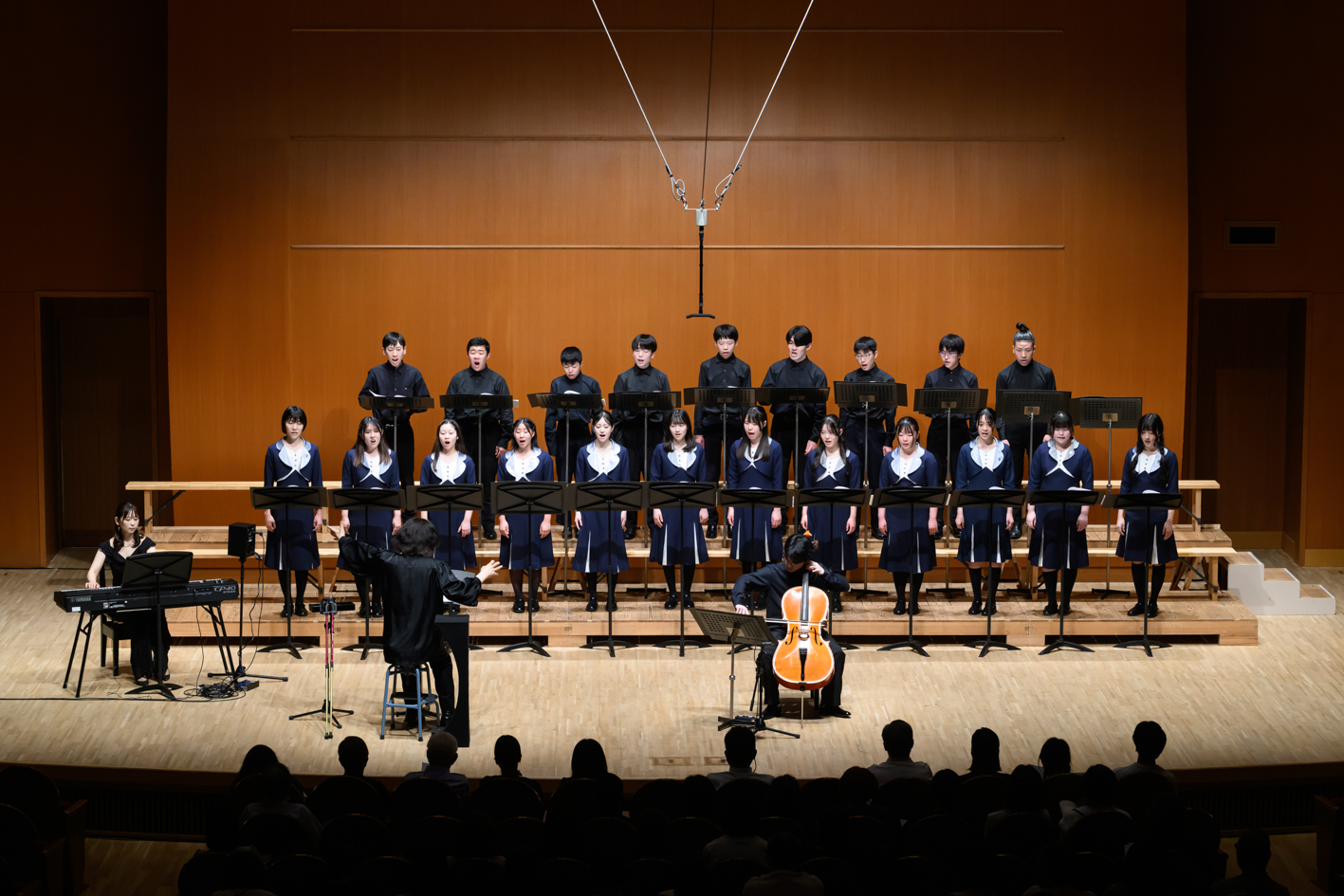
Now to Umemoto’s new work presented this time, “dumb trick.” The title means something like a pointless prank, a trivial little trick. The suite runs to ten numbers in total; No. 1, a solo cello piece performed by Soshi Hara, opens with a simple, natural major-scale melody. But dissonance is subtly worked in, and the following No. 2 turns the carefree quality of No. 1 into a refrain in minor key, as the world begins to take on a shadow. The suite is built around solo cello and choir, and as for why cello, it’s because this instrument
What followed was a powerful anthem, Ben Nobuto’s “Sol.” Nobuto is a composer Umemoto admires—a much-talked-about 30-year-old who combines internet culture and pop elements with humor and irony, and this is one of his popular pieces. “Sol” means sun, and according to the composer himself, its motif is a “little sun cult” singing and dancing in praise of an ancient Roman sun god. The “fragmentation” characteristic of his music shows, for instance, in the way each individual note forming the melody is scattered across solo vocal parts, so that traditional harmonic development transforms almost instantly. It’s an exhilarating, bright dynamism that could only come from digital maximalism, and it makes the heart race.
The overall mode is a transposition of bodily sensation—the brain going hazy with heat while sunbathing, something like meditation or intoxication. Among pop songs celebrating the sun, the two giants are the Beatles’ “Sun King” and Antônio Carlos Jobim’s “Estrada do Sol,” and it’s interesting that a similar sonic approach is present here (though whether these two songs were part of the composer’s “input” is unknown). Classical music has expressed the narrative, lyricism, emotion, and philosophy that humans crave, but the contemporary music that has inherited that baton takes clear aim at sensations and textures that spill out beyond words, at zoning, at the realm of the unconscious.
Next was Umemoto’s own choral piece, “dumb trick #3.” The harmony in the lower voices wavers, and above it comes a lark-like unison voice, “catching its breath” in little sobs. The transformation from the mythic world of the previous piece into a natural world emptied of humanity recalls Messiaen’s “Des canyons aux étoiles…” Birds, incidentally, have long inspired classical composers. Ryuichi Sakamoto, too, left behind a little-known late masterpiece called “hibari” (“Skylark”).
Next came dumb trick #4 and #5. The cello solo of No. 4 is an immaculate world reminiscent of Bach, built on repeating scales. No. 5, by contrast, turns to low, abstract sound.
Then, another Ben Nobuto piece: “FACE ANTHEM.” The repetition of “cute, childlike” fragments—the unison of mi-do-mi-so-do and mi-re-do-la-so, the shout of “Yeah!,” the repeated chime of a metal bell—gets dismantled of its comfort as the music progresses, coming to resemble an automaton out of control. Toward the end you can even hear the noise of a screwdriver turning, which recalls Offenbach’s opera “The Tales of Hoffmann.” This sense of something beautiful and good curdling into madness is a horror-genre staple, and here the composer is fully in his element.
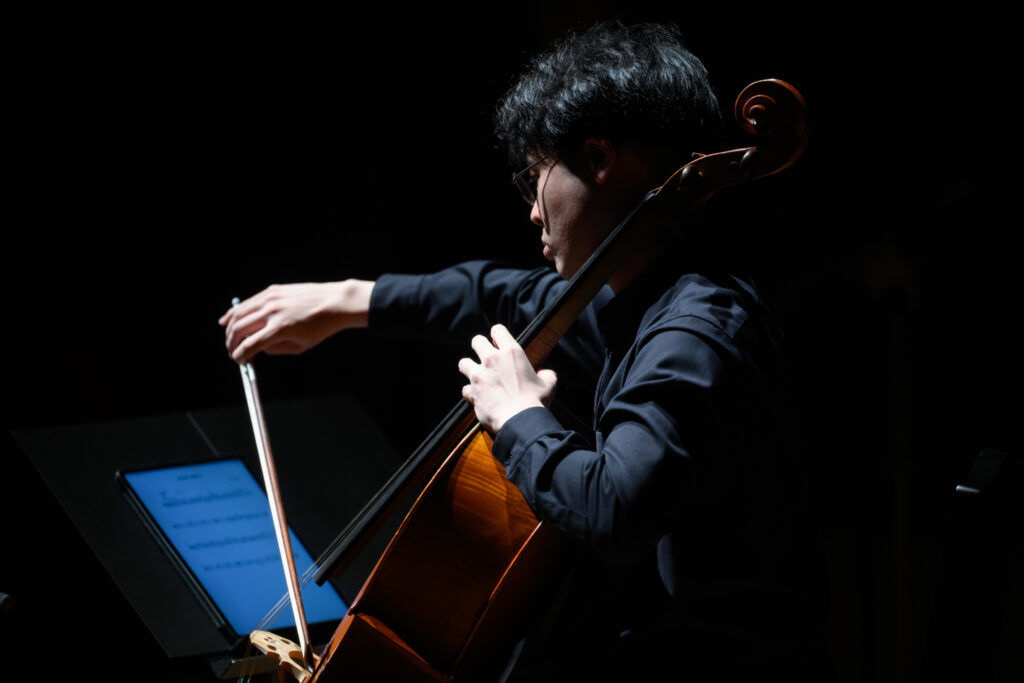
Photo: Fumiaki Fujimoto
Next, Umemoto’s “dumb trick #6” is a cello solo, a free-flowing melody that seems to leap over the yoke of form and style, as if a lyrical spirit had been set loose. But long tones that slide downward in a falling glissando throw cold water on the romance.
Then came the choral piece that gave the suite its title: “dumb trick #7 – I forgot the song and cried.” It unfolds like traditional church music with no gimmicks at all, just the repetition of the same phrase, varied only in dynamics. “Doing less to make the experience more concentrated” is the essence of tea ceremony, and I read this as a conceptual “return serve” aimed at Ben Nobuto’s choral piece, which is thick with dazzling ideas and gimmicks! The almost stubbornly plain repetition of “I forgot the song and cried” seeps into the soul.
The next piece, “dumb trick #8,” surprised me right from the start. Unlike the solo cello pieces so far, it sounds from the outset like a traditional European sarabande. The choral piece right before this one was “I forgot the song and cried,” which makes this one, in effect, a rite of passage into adulthood. The worldliness of this dance is a living likeness of social life itself—proof, perhaps, that beyond forgetting the song and crying, there wait the songs one needs to survive: anthems that root for you through life, torch songs of heartbreak.
The choral piece that might be called the highlight of the suite is titled “dumb trick #9, I can’t sing.” The lyrics run something like: “I can’t sing because of you. It’s not your fault I can’t sing. I can’t sing because of me. It’s not my fault I can’t sing. I love you. I love you. I love you…” The words resonate within a simple, classical harmonic progression. Unlike No. 7, these lyrics carry clear meaning. And the refrain of “I love you” sung at the end is superb—a phrase anyone can catch, a cliché worn smooth from endless use across every era and culture. At the end of the long journey Umemoto set out on with this concert, how this “I love you” lands with each individual listener was really the crux of the whole thing.
And then, the closing piece for cello, “dumb trick #10.” A melody as natural as humming a tune to oneself, for oneself alone. With no great development, it quietly fades away, much like the final movement of Mahler’s Ninth Symphony.
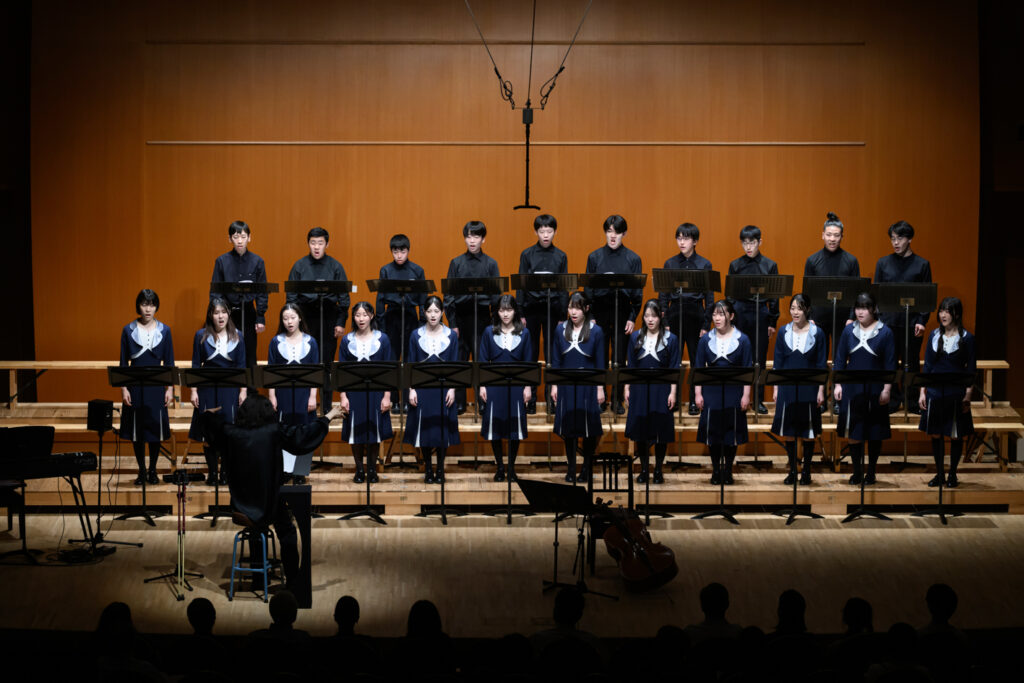
Photo: Fumiaki Fujimoto
Looking ahead to what comes after classical music, I believe the field with the most potential is choral music. In instrumental music, centered on the piano, competitions have come to resemble either an Olympics chasing medals or a University of Tokyo entrance exam built around cram schools like Sapix—and there is an inconvenient truth that fan support for the winners is what props up the industry’s economics. As is well known, mastering an instrument or classical vocal technique takes time and money, and while the result may be polished, it often ends up incapable of conveying the one thing that actually matters: the appeal of the music itself.
Choral music, in that respect, is different: anyone who possesses the instrument called a voice can take part, and with enough motivation and proper guidance, anyone can “perform” Bach, Handel, or Yuri Umemoto. Each individual’s “motivation to express” doesn’t run up against the wall of technique the way it does in instrumental music, and the joyful vibe of that music reaches the audience beautifully, intact. Lately I’ve been going to choral concerts, professional and amateur alike, and I’m surprised at how many genuinely uninvolved members of the audience there are, more than I expected. Truly good performance moves people. Anyone who has experienced a great performance at a pop concert will understand this directness.
Umemoto himself has said in an interview that, for him, the appeal of choral singing lies in the fact that becoming a singer and raising one’s voice within a group blurs the outline of the self and grants a kind of anonymity.
Choral music’s roots lie, to begin with, in the Christian church choir. Before the modern era, when childbirth was a life-or-death matter and people suffered under famine, plague, and heavy taxes, living itself was terribly hard. By surrendering themselves to the church’s choral music, people could, if only for a moment, stop being “a hundredfold-suffering human being.”
Now, unlike back then, food, clothing, and shelter are abundant, and a safe, healthy life has been realized. Yet with AI’s advance blurring the outline of what a human being is, this feeling of “maybe it’s okay to stop being human” seems, far from disappearing, to be growing stronger. Posthuman desires to move beyond humanity, desires to become animal or return to nature as in Sayaka Murata’s novels—these no longer feel like sci-fi fantasy, but seem to be starting to feel like the reality of the near future.
Sexual desire, appetite, romantic love that wounds people so deeply, and all the other troublesome burdens of actual life and the body… Perhaps liberation from it all may be found in the musical act called choral singing.
Translated by Ilmari Saarinen